Letters look fine alone. Then your child joins them into a word.
Give joining its own practice time. This 19-page printable PDF moves from two-letter joins to short words on Indian four-line ruling. For Class 2 and Class 3 children whose capital and small letters already sit on the lines. Rs 149, one payment.
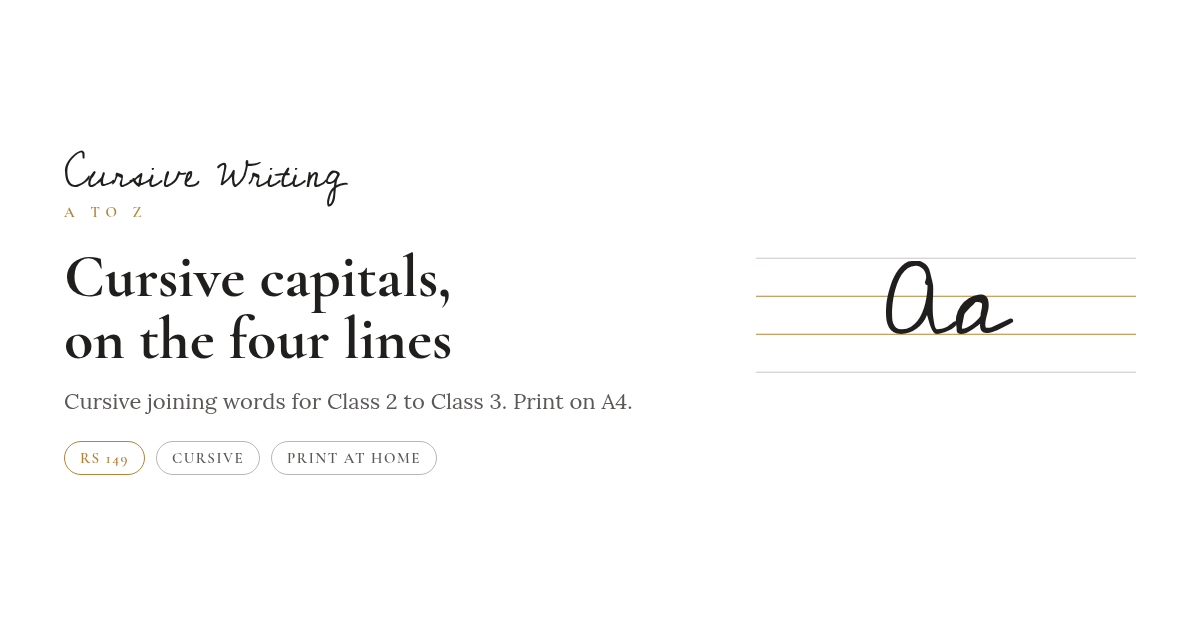
Get the A to Z book, Rs 149One A4 sheet for every letter, on the ruling in your child's school copy. Ordered on a form, paid by UPI, emailed to you. Ask for the free capitals A to H pack first if you want to see a sheet used tonight.
Your child can write a small letter neatly when you ask for it.
But put that letter inside a word, and something changes. One letter becomes too tall. The next slips below the line. The joining stroke takes so much attention that the word no longer sits neatly in the four-line notebook.
Then the school notebook comes home with another red remark:
"Letters not on the line."
"Size not proper."
You ask your child to write slowly. They do. Yet the same part of the word goes wrong again.
The next thing to practise may not be the whole alphabet. It may be the movement from one letter to the next.
The Cursive joining words book gives that movement its own practice space: two-letter joins first, then short words, on familiar Indian four-line ruling.
19 printable A4 pages. Rs 149, one payment.
Submit your order, receive a UPI request by email, and get the PDF by email after payment.
When knowing the letters is not the same as joining them
Writing a letter on its own gives your child a clear beginning and end.
Joining asks for something more. The child has to finish one letter, move into the next, and keep both letters at the right height.
That is a lot to watch while also remembering the spelling of a word from the homework book.
You may recognise this in your child's copy:
- Separate letters look better than joined words.
- Small letters become different sizes within the same word.
- A joining stroke pulls the next letter away from its proper place.
- The first word is careful, but the rest of the line becomes uneven.
More pages of the same homework can feel like more of the same problem.
This book narrows the task. Instead of asking your child to manage a whole sentence, begin with just two letters and the join between them.
What happens at the study table
The tiffin box is washed. Homework is nearly finished. You open the copy and point to a word.
"See this one. Write it properly."
Your child erases it. Writes it again. You point to the size this time. Now the page has pencil marks, rubber dust, and one very tired child.
For joining practice, make the instruction smaller.
"Today, let us watch how this letter goes into the next one."
You do not have to correct every part of the handwriting in one sitting. Choose one thing to notice: where the join goes, whether the next letter stays at the right height, or whether the word stays on the lines.
Ten focused minutes can have a clear purpose without becoming another full homework session. It is a practice routine, not a promise of perfect handwriting in a week.
What this file actually is
The Cursive joining words book is a 19-page A4 PDF for printing at home or at a xerox shop.
It moves from two-letter joins to short words. Every practice page uses Indian four-line ruling only, so your child is not switching to an unfamiliar line format for this skill.
Small letter bodies sit between line 2 and line 3. The point is to keep paying attention to those positions as letters become words.
This is a focused joining book, best suited to Class 2 and Class 3 children whose capital and small letters already sit on the lines.
It is not a physical book delivered by courier. You receive the PDF by email after payment and print the pages you need.
How a week of ten minutes can look
You do not need to finish one page every day. A useful session can be a small part of a sheet, repeated with attention.
Here is one way to use the book during the first week.
Day 1: Look at one join
Choose a two-letter join from the book.
Ask your child to notice where the first letter finishes and how the next begins. Keep the amount of writing small. Today is about seeing the connection, not filling the sheet.
Day 2: Repeat without rushing
Return to the same join.
Watch the movement between the letters. If your child gets stuck, point to that part rather than asking for the entire line again.
Day 3: Check the letter size
Use a two-letter join and look at the small letter bodies.
Are they staying between line 2 and line 3? Choose one attempt that does this well and ask your child what they notice about it.
Day 4: Practise another join
Move to another two-letter join when the first feels more manageable.
Keep the same simple check: the connection between letters, then their position on the four lines.
Day 5: Move into a short word
Choose a short word from the book.
The task is now to keep the letters in place while joining them. There is no need to add speed as another target.
Day 6: Revisit the difficult part
If one join keeps disturbing the word, return to that smaller movement.
You can reprint a sheet for your family's practice. A fresh copy lets your child work on the same task without squeezing writing into an already crowded page.
Day 7: Look back together
Compare an earlier attempt with today's work.
Notice something specific if it has improved: a steadier letter size, a clearer connection, or a word sitting better on the lines. If the same join is still difficult, give it more time next week.
The routine stays small enough to fit around schoolwork. Progress decides the pace, not the page count.
The price is Rs 149
Rs 149 buys the complete 19-page joining words PDF. It is a one-time payment.
Printing is separate. You can print at home or take the PDF to a xerox shop, where a black-and-white set may cost about Rs 20 to Rs 30, depending on the shop's rates.
The reason to choose this book is specific: your child already knows the letters, but needs practice keeping their shape and position while joining them.
You do not need to buy another pack alongside it to begin that work.
How to order today
Ordering currently works through a form and an emailed UPI request.
- Fill in the order form below for the Cursive joining words book.
- Check your email for a UPI request for Rs 149. A person sends this request.
- Complete the UPI payment.
- Receive the PDF by email after payment.
Please enter your email address carefully. That is where the payment request and the book will be sent.
Card checkout is not available yet. PayU is coming through this site's own merchant account. For now, the order form, UPI request, and email delivery are the purchase process.
Print it like school practice, not a shrunken worksheet
Use A4 paper at 100 per cent scale. Do not select "fit to page".
Black and white is fine.
If you are using a xerox shop, ask them to keep the page at its original size so the four-line ruling is not reduced.
You can reprint a sheet as often as your family needs. Please do not forward the PDF to other families.
Questions before you order
Is this the same ruling as Indian school notebook?
The book uses Indian four-line ruling only. Small letter bodies sit between line 2 and line 3. Your child practises joins while continuing to pay attention to that familiar line placement.
My child is in UKG or Class 1. Should I buy this?
Choose by readiness as well as class. This joining book is intended mainly for Class 2 and Class 3 children after both alphabets sit on the lines. If your child is still learning individual capital and small letter shapes, the A to Z pair, Rs 149 is the more suitable purchase.
What if the letters are neat alone but untidy in words?
That is the practice need this book addresses. It begins with two-letter joins before moving to short words, so you can work on the connection between letters without beginning with a full sentence.
Do we have to complete a page every day?
No. Use ten minutes as a manageable practice slot, not a page-completion target. Stay with a small section when your child needs more time, and repeat a sheet if useful.
Will the handwriting improve in seven days?
There is no fixed seven-day result. The weekly routine above is a suggested way to use the book. Children need different amounts of repetition, and neat work on a practice sheet may still take time to carry into school notebook.
Is Rs 149 for a printed book?
No. Rs 149 is for the complete 19-page PDF, delivered by email after payment. Printing is separate. Print at home or at a xerox shop.
How do I pay?
Submit the order form. A person emails a UPI request for Rs 149, and the PDF is emailed after payment. Card checkout is not live yet. PayU is coming through this site's own merchant account.
Is there a smaller alternative if we are not ready for joining?
The free A to H pack covers capitals A to H. It is a smaller alphabet-practice option, not a replacement for this 19-page joining words book.
Can I print the same page again?
Yes. Reprint sheets as often as your family needs for practice. Please do not forward the PDF to other families.
Give the difficult join a smaller job
The next time you see "size not proper" in the school notebook, you do not have to turn the whole evening into rewriting.
Set aside ten minutes. Choose a join. Watch where the next letter begins and whether it stays on the lines.
Then, when your child is ready, bring that movement into a short word.
Get the Cursive joining words book: 19 A4 pages on Indian four-line ruling, Rs 149.
Order the complete PDF. Receive a UPI request by email, then the book by email after payment.
Page updated 2026-09-05.